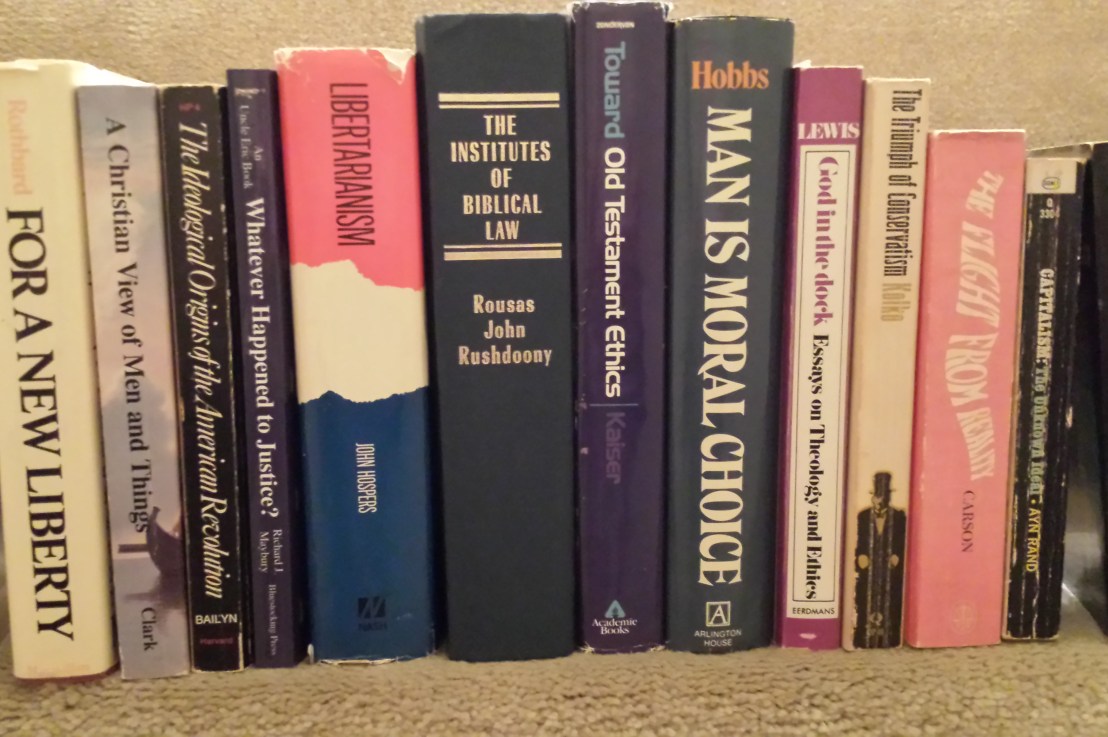
I’ve recently finished reading several books that, broadly speaking, focus on the question of the relationship between Christianity and our nation‘s founding. For my own curiosity, I’ve decided to express my beliefs on the question. The three books I’ve read recently on this were: Defending the Declaration by Gary Amos, Reading the Bible With the Founding Fathers by Daniel Dreisbach, and Was America Founded as a Christian Nation? by John Fea.
Defending the Declaration was interesting in the way it traced the wording of individual phrases of the Declaration to a long history of Christian thought. The author’s conclusion? “The American Revolution … was ‘Christian’ in that all the principles included in the Declaration of Independence agreed with, and probably grew directly from, the Biblical teaching about revolution as formulated by major Catholic and Protestant theorists over a span of seven hundred years.” (p. 149)
Reading the Bible was interesting because it is one of the few books I’ve seen on this subject that is written by someone who appears to know the Bible. Many histories on this subject seem to overlook any reference or allusion that isn’t a direct quote. Many historians have noted the heavy influence of the Bible on 17th & 18th century American culture, but Dreisbach proves it. His conclusion: “From the Pilgrim fathers to the founding fathers and beyond, Americans have looked to the Bible for guidance in creating and administering a well-ordered political society. … [N]o source was better known or more authoritative and accessible in their culture than the Bible. Christianity in general and its Sacred Text in particular shaped many of the underlying values, beliefs, and assumptions that informed their political thought and were vital to the construction and administration of their system of laws and civil government. ….[Also,] ideas derived from other sources were often evaluated in the light of Scripture, and the founding generation looked to the Bible to strengthen, validate, or sanctify ideas emanating from these other sources.” (p. 234)
But the most interesting book – because it is so infuriating – is John Fea’s book. The book purports to answer the question Was America founded as a Christian nation, but fails miserably. The first issue is that the terms are discussed, but never defined. Especially crucial is, what does Fea mean by a “Christian” nation? I cannot find a definition, which allows the author to denounce various actions and beliefs as not part of a Christian heritage. For example, he criticizes the colonists as not being theologically pure. But to what? To Calvinism, appears to be the answer at one point. But that means the Quakers in PA and the Church of England parishioners in VA both prove America was not Christian. Say what?
Fea also argues the documents of this era do not have Christianity embedded in them. These are political documents, and the Bible is sparse on details of the type and format of government God wants. When historians say a country is Christian, they mean things like what is the source of the ethical values underlying the laws, and what values are appealed to as the justification for the actions being taken.
Most of the evidence presented in this regard clearly shows that Christianity was the dominant world view of almost 100% of the leaders and people. This is done even when totally ignoring crucial issues such as the foundation of the Common Law (which formed the basis of all colonial law), the evidence of Christianity applied in people’s lives presented by commentators such as Alexis De Tocqueville, and the significance of the church service dedicating the nation to God performed on the first day of the new government in 1789.
Unfortunately, the author makes the mistake of “reading back” into history. Unfortunate though it may be, few Christians of that era understood that slavery and Christianity were incompatible. (Christianity and racism are also incompatible. Does that mean that no person who made a racist statement can be called a Christian? Obviously not.) Worse, the author appears to view history through Enlightenment eyes. Historians have tried mightily for a long time to prove that America was a product of the Enlightenment. To do so, they’ve associated ideas such as natural law and rights as Enlightenment ideas, ignoring the long line of Christian thinking, based on Paul’s writings, behind those concepts. Fea does not attempt to set the record straight.
So was America founded as a Christian nation (not a theocracy, but Christian), or was it a product of the Enlightenment? The answer is obvious to anyone who approaches the question in an open manner. When defined as above – as the ideal being sought, the source of the underlying values and justification for community/governmental actions – the answer to his question must be a resounding “yes.” That such an answer is not what the author likes, or is used by others in ways that cannot be justified, does not change the answer.
Parenthetically, it is both amusing and ironic that the author makes the claim he is both a “Christian and a Christian college history professor.” Fea is identified as a professor at Messiah College, a college that, at one time, was closely associated with the Brethren in Christ church. I know a little about Messiah. I would ask Fea in what way he defines “Christian” in this connection. My understanding is you will not find a monolithic doctrinal belief among either the faculty or the students. Nor do all practice the doctrines they speak. The driving focus of the school has long ceased to be religious in nature, and many documents coming out of the college scarcely mention God. Is he lying, or does his statement have validity? I think it does, but seeing that it does will illuminate the way America was founded as a Christian nation.
 Askance Eye Miniblog
Good post. An interesting book to read is “The Light and the Glory” by Peter Marshall and David Manuel.
LikeLike