Category: Christian Culture

Disturbing Research!

Disturbing Research!

Barna (and Summit Ministries) has published a very disturbing study of America’s Christian culture.  And if you’re the kind of person that needs to be able to put your finger on the cause of why our world’s in the shape it’s in – it’s in there!

The research report is entitled “Competing Worldviews Influence Today’s Christians.”  Here’s a snippet of what they found:

“Here are a few notable findings among practicing Christians:  61% agree with ideas rooted in New Spirituality;  54% resonate with postmodernist views;  36% accept ideas associated with Marxism;  29% believe ideas based on secularism.”  Here’s a few of the specific examples given:  “almost three in 10 (28%) practicing Christians strongly agree that ‘all people pray to the same god or spirit, no matter what name they use for that spiritual being…;’  Almost one-quarter of practicing Christians (23%) strongly agree that ‘what is morally right or wrong depends on what an individual believes…;’  only [ ! ] 13 percent of practicing Christians strongly agree that ‘a person’s life is valuable only if society sees it as valuable.’”

(View the entire story at:  https://www.barna.com/research/competing-worldviews-influence-todays-christians/.)

Culture is a reflection of the religious and ethical views of a society.  Christians are called to be a light to the world, to uphold truth to those who are, or want to be, in darkness.  Indeed, as the world so spitefully acknowledges, western civilization rests on the core truths long espoused by the Christian.  Yet, “almost one-quarter of practicing Christians (23%) strongly agree that ‘what is morally right or wrong depends on what an individual believes,” not on what God has said.  If a quarter of those who should be setting the tone for society have lost their way, how can we blame society?  That 13 percent of society would see a person’s life as valuable only if the crowd does is disheartening, but that 13 percent of Christians say that is appalling!

Have they never heard of the Bible?

In ancient history, the Israelites had a long history of ‘doing what was right in their own eyes.’  It never served them well, always leading to oppression and defeat.  But God told them if they would turn to Him for leadership, and repent (that is, change their ways) and follow Him consistently, He would “heal” their country.

Our actions are mimicking those early Israelites.  Our results are no better than theirs.  Perhaps it’s time we see if God’s invitation is still open and His promise still true.

Musings – on Understanding

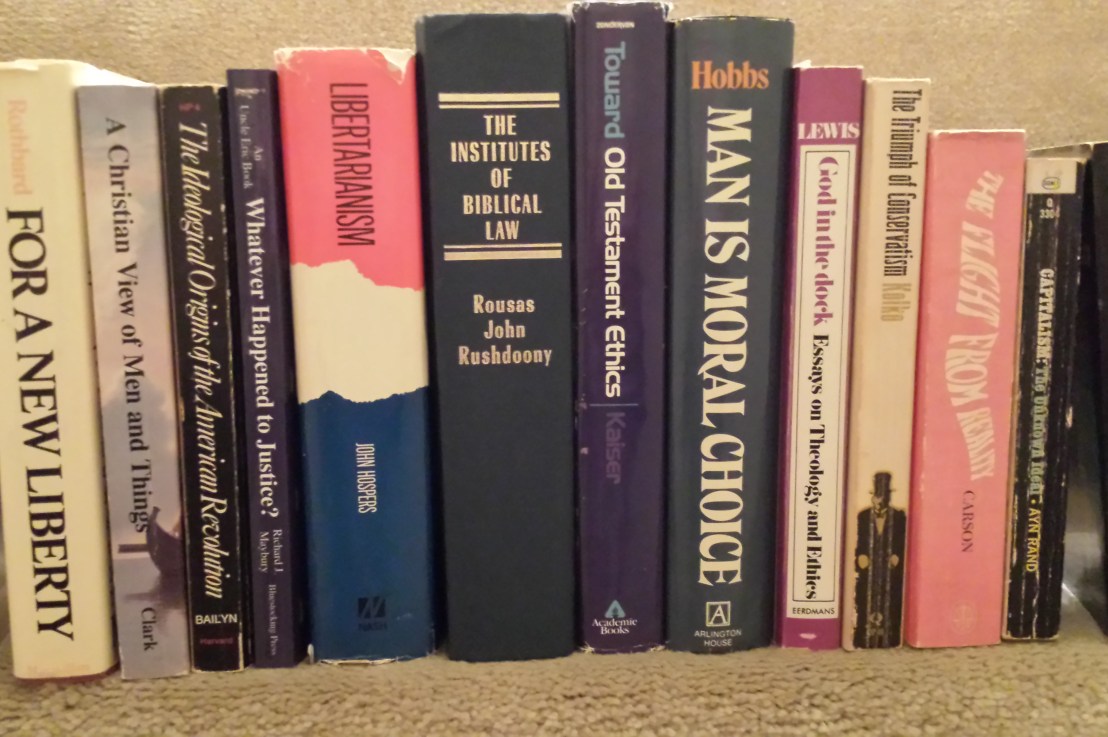
The other day I was looking over the books in my library, facing the tremendous difficulty of trying to decide what books I can remove in order to make way for new books.  It’s such a difficult situation, because a person never knows just what thought or fact you would need to review while trying to make sense of things.  It’s the ideas gleaned from many books that provide the explanatory framework around which new facts are analyzed and fitted.

As I often do, I was thinking of the political scene, and wondering which book(s) would help bring understanding out of the chaos.  How can you make sense out of chaos?  Then my thoughts jumped to the more philosophical question – how can you make sense of randomness?

According to the going scientific story, the world is the result of randomness.  The driver of evolution is the mutation of a gene, a mistake that happens randomly, with no outside direction or teleological goal.   When enough of these happen in a right combination, a new organ or even species is presented for our amazement.  But if the world is, in the final analysis, a random collection of mutations that made good, how can it be made sense of?  Doesn’t ‘making sense’ of something require an order, a blueprint, a design by which to interpret it?

Then my mind went back to a short lecture I heard from a Penn professor quite a few years ago.  It was from what they called “The 60-second lecture series,” in which Penn faculty “distill[ed] a thought into an eloquent and brief message” presented to students and alumni.

In a lecture entitled “the Knowable Universe,” Professor Vijay Balasubramanian  (Physics department) said the following.  “The most amazing thing about this world of wonders is that we can understand it.  It is not at all evident why this had to be the case…there is no compelling reason why the inner workings of the universe should be comprehensible to us.”

That’s exactly the conclusion you must come to when you think about trying to make sense of random mutations.  Of course, you can follow the Existentialists, and decide there truly is no order, so therefore we, as humans, must impose some type of order on the world.  But that obviously doesn’t cut it; even a two-year old knows you fall when you jump off the bed.

Prof. Balasubramanian continued his thought.  “But it (understanding) is the case, and there are two reasons why.  First, underneath all of the immense complexity and apparent randomness of the natural world, there seems to be an intricate order…What is more, the human mind can apparently understand the underlying structure in the universe…there is no compelling reason why the inner workings of the universe should be comprehensible to us.  But they are.  The human mind apparently apprehends the abstract patterns within the universal weave.”

He went on to give an example.  “We can give a complete description of the physics of light in four short equations that would fit on a T-shirt.  Nature is replete with such miraculous orderly relations.”

Without the underlying order, there simply cannot be an understanding, a comprehension of the world around us.  Randomness, on a grand scale, yields chaos, not understanding.

Every one of the books on my shelves, the philosophy, the economics, the history, all attempt to make sense of the universe by applying theories of order, of design, of logical connections.  Naturalism, the current version of our scientific worldview, simply destroys their foundation.

Only the Christian worldview, which sees the world as the result of a logical mind, provides a firm foundation for understanding the world.

(The 60-Second Lecture Series copyrighted 2007 by Univ. Of Penn Trustees)

Meddling 1

Certain circumstances have led me to consider again the idea that we must be passionately dedicated to God- to truth – if we are to make a real difference in this world.  Our passion for God – which translates to a passion for truth – must inform everything we do or say.  It must become our ‘prime objective.’

This is nothing new for the Christian, at least in thought.  Almost all would claim to agree with Jesus’ statement that we must love God with all our heart, soul, mind and strength.  This ‘first commandment’ simply states what I said above.  But many Christians allow for slippage between the saying and the doing!

Only a dedicated, consistent life, dedicated to living truth, will get us to our objective of pleasing God and of living the good life, as the Greeks called it.

We should evaluate all thoughts and actions from that ‘single issue’ point of view.  Does that mean nothing else matters?  Of course not, but lesser matters must conform to the major one.  Does that mean fun is not allowed?  Of course not, but it must be fun that, at least, does not denigrate our goal in life.

Some issues very obviously further, or conflict with, our prime objective.  For others, it takes a long train of reasoning to determine if it furthers or conflicts with our supposed first love.  Unfortunately, many people, in many areas of life, do not do that reasoning.  They simply take their cue from the world around them, meaning that, in actual fact, their actions are often in conflict with their stated values.

A Random Christmas Thought

I’ve watched several movies this Christmas season – the syrupy kind running on the Hallmark channel.  I’d be the first to admit they are not good literature, but I like them, because they are about the only thing you can find close to the romantic tradition on TV nowadays.  (You know, in the tradition of Love Story or She Lives!)  The plot’s always (in a generic way) the same – boy meets girl, they go through trying times, and something about Christmas pulls them together and makes everything right.  But what’s so interesting is, the “something about Christmas” is always values such as “family” or love or forgiveness.  I know the world seldom works that way.  But you know what?  It can.

The values being touted are not unique to Christmas.  Instead, they are the values found in the Bible and preached every Sunday in pulpits around the country.  But culture only finds it acceptable to promote those values when disguised as Christmas values.  Well, they are values associated with Christmas, because they are indeed based on the God that came to earth then.  But why are those values only embraced (by most) for six weeks out of the year?  I can show you many examples of how living those values all year can lead to peace, happiness and contentment year ‘round.  He’s not only the reason for the season, He’s what holds the rest of the year together also.

Merry Christmas, to all who read this!