Category: Political-Economics

Baseball v. truth

Baseball v. truth

The Fresno Grizzles were embarrassed when a video they showed between Memorial Day games had some unexpected editing in it.  The video had a speech by former President Reagan praising American troops.  But in a statement talking about “enemies of freedom,” the editors showed several pictures of such enemies – including Fidel Castro and Rep. Alexandria Ocasio-Cortez (AOC).  The Grizzles apologized, saying the video was “misleading and offensive” and did not portray their opinion.

Now I assume the Grizzles’ front-office managers know more about baseball than do the editors of the video.  But they clearly have no understanding of politics or economics or history.  Politics, economics and history all clearly show socialism is, indeed, an enemy of freedom.  AOC is a socialist.  Even someone who doesn’t know the word syllogism understands the deduction that AOC is, therefore, an enemy of freedom.

Socialism requires some sort of central planning; freedom, with its ability to change course and make new deals rejects the concept of a national, central plan.  Economic freedom allows all participants in the market to pursue their own goals; socialism is premised on the edicts and dictates of the elite who set the vision for the group.  Historically, it has been the socialist countries who have had gulags and forced mass starvation; countries with less government interference in society have allowed people the chance to grow and blossom as individuals.

The Green New Deal is, undoubtedly, the most radical socialist scheme ever “seriously” proposed in modern times.  Calling AOC an “enemy of freedom” is a mild epitaph.  To identify the conjunction as “offensive” is itself offensive – and sad.

Christianity And Our Founding

Christianity And Our Founding

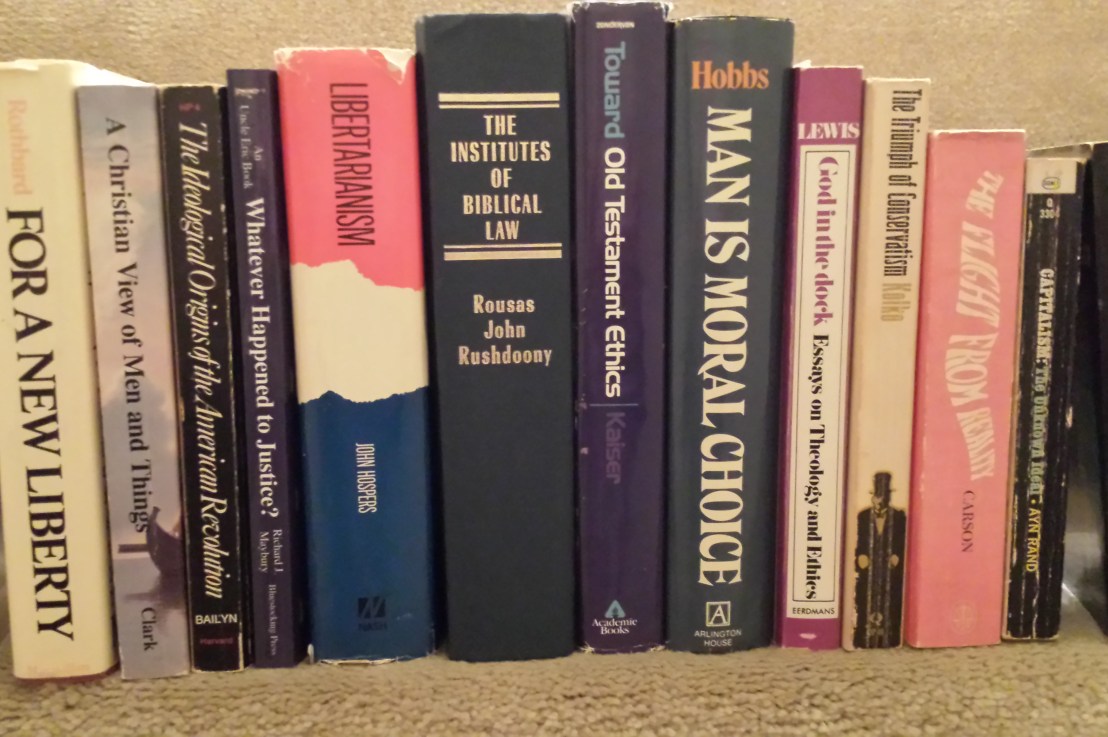
I’ve recently finished reading several books that, broadly speaking, focus on the question of the relationship between Christianity and our nation‘s founding.  For my own curiosity, I’ve decided to express my beliefs on the question.  The three books I’ve read recently on this were:  Defending the Declaration by Gary Amos, Reading the Bible With the Founding Fathers by Daniel Dreisbach, and Was America Founded as a Christian Nation? by John Fea.

Defending the Declaration was interesting in the way it traced the wording of individual phrases of the Declaration to a long history of Christian thought.  The author’s conclusion?  “The American Revolution … was ‘Christian’ in that all the principles included in the Declaration of Independence agreed with, and probably grew directly from, the Biblical teaching about revolution as formulated by major Catholic and Protestant theorists over a span of seven hundred years.” (p. 149)

Reading the Bible was interesting because it is one of the few books I’ve seen on this subject that is written by someone who appears to know the Bible.  Many histories on this subject seem to overlook any reference or allusion that isn’t a direct quote.  Many historians have noted the heavy influence of the Bible on 17th & 18th century American culture, but Dreisbach proves it.  His conclusion:  “From the Pilgrim fathers to the founding fathers and beyond, Americans have looked to the Bible for guidance in creating and administering a well-ordered political society. … [N]o source was better known or more authoritative and accessible in their culture than the Bible.  Christianity in general and its Sacred Text in particular shaped many of the underlying values, beliefs, and assumptions that informed their political thought  and were vital to the construction and administration of their system of laws and civil government.  ….[Also,] ideas derived from other sources were often evaluated in the light of Scripture, and the founding generation looked to the Bible to strengthen, validate, or sanctify ideas emanating from these other sources.” (p. 234)

But the most interesting book – because it is so infuriating – is John Fea’s book.  The book purports to answer the question Was America founded as a Christian nation, but fails miserably.  The first issue is that the terms are discussed, but never defined.  Especially crucial is, what does Fea mean by a “Christian” nation?  I cannot find a definition, which allows the author to denounce various actions and beliefs as not part of a Christian heritage.  For example, he criticizes the colonists as not being theologically pure.  But to what?  To Calvinism, appears to be the answer at one point.  But that means the Quakers in PA and the Church of England parishioners in VA both prove America was not Christian.  Say what?

Fea also argues the documents of this era do not have Christianity embedded in them.  These are political documents, and the Bible is sparse on details of the type and format of government God wants.  When historians say a country is Christian, they mean things like what is the source of the ethical values underlying the laws, and what values are appealed to as the justification for the actions being taken.

Most of the evidence presented in this regard clearly shows that Christianity was the dominant world view of almost 100% of the leaders and people.  This is done even when totally ignoring crucial issues such as the foundation of the Common Law (which formed the basis of all colonial law), the evidence of Christianity applied in people’s lives presented by commentators such as Alexis De Tocqueville, and the significance of the church service dedicating the nation to God performed on the first day of the new government in 1789.

Unfortunately, the author makes the mistake of “reading back” into history.  Unfortunate though it may be, few Christians of that era understood that slavery and Christianity were incompatible.  (Christianity and racism are also incompatible.  Does that mean that no person who made a racist statement can be called a Christian?  Obviously not.)  Worse, the author appears to view history through Enlightenment eyes.  Historians have tried mightily for a long time to prove that America was a product of the Enlightenment.  To do so, they’ve associated ideas such as natural law and rights as Enlightenment ideas, ignoring the long line of Christian thinking, based on Paul’s writings, behind those concepts.  Fea does not attempt to set the record straight.

So was America founded as a Christian nation (not a theocracy, but Christian), or was it a product of the Enlightenment?  The answer is obvious to anyone who approaches the question in an open manner.  When defined as above – as the ideal being sought, the source of the underlying values and justification for community/governmental actions – the answer to his question must be a resounding “yes.”  That such an answer is not what the author likes, or is used by others in ways that cannot be justified, does not change the answer.

Parenthetically, it is both amusing and ironic that the author makes the claim he is both a “Christian and a Christian college history professor.”  Fea is identified as a professor at Messiah College, a college that, at one time, was closely associated with the Brethren in Christ church.  I know a little about Messiah.  I would ask Fea in what way he defines “Christian” in this connection.  My understanding is you will not find a monolithic doctrinal belief among either the faculty or the students.  Nor do all practice the doctrines they speak.  The driving focus of the school has long ceased to be religious in nature, and many documents coming out of the college scarcely mention God.  Is he lying, or does his statement have validity?  I think it does, but seeing that it does will illuminate the way America was founded as a Christian nation.
The Swiss Look in a New Direction

The Swiss Look in a New Direction

Every once in a while, a news article allows a glimmer of light to shine through.  One such story a few days ago (sorry, I don’t have the url) discussed the Vollgeld Initiative in Switzerland.  The initiative would eliminate fractional reserve banking.  Fractional reserve banking is the policy that allows banks to ‘create’ money, by allowing them to loan out several dollars for each dollar of reserve (i.e. savings) they hold.

Fractional reserve banking is, thus, a major part of the impetus behind inflation.  (Inflation is the expansion of the money supply, which causes evils such as the dilution of the purchasing power of each dollar and the initiation of the business cycle of ‘booms and bursts’ that has caused so much havoc during the last century.)

The news’ nickname for this was called the Sovereign Money initiative, so obviously – although it didn’t give specifics that I saw – the state would still exercise control over the money supply.  While the state controls the money, evils such as inflation would only be mitigated, at best.  But it seems like a step in the right direction.

I mention and discuss briefly the moral reasons for an end to fractional reserve banking, as well as to state control of a country’s financial system, in my book Walk In It, (still available from Amazon.)  Every once in a while, ideas that are right philosophically and morally are proposed politically.  When it happens, such ideas deserve our consideration and support.

Another Class Issue

Another Class Issue

Following modern politics is always an interesting occupation.  Take the latest article I read explaining how to effect a shift in power in Washington.

The question presented was, what would it take for the Democratic Party to win again?  “And again, it comes back to class,” was the answer.

Now, I don’t doubt the truth of the statement necessarily.  But the argument to get there was concerning!  At one point, the idea was that they should learn from the success of Trump.  Trump “won whites of all genders, all ages, all incomes and all levels of educational attainment.”  He did it by appealing to the anti-establishment, anti-elitist feelings of the people.

For a Democrat, obviously that won’t work.  But a review of history gave the author the answer.  As the title proclaimed, “Democrats used to campaign on class — and win. It’s time to do it again.”

Of course, the Democrats have complained for months now that Trump is tearing the country apart by sowing disunity.  But nothing tears a country apart faster and more deeply than class warfare, as it uses both economic and cultural forces to pit one group against another.  And unfortunately, the author is correct: the Democrats have used class warfare to win since at least 1932.  Since FDR, the Democrats have based their campaigns on economic (i.e. Marxian style) class warfare, not caring a wit for its destructive results.

Whether self-consciously or not, Trump’s rhetoric has been based, not on economic class warfare, but on political class struggle.  It’s a case of everyone – rich, poor, black, white, male, female – against the “in” crowd, against the politically connected elite.  For those who have no political pull, who are net payers of tribute (to use the old word for taxes) to the denizens of Washington, Trump was the voice they hadn’t had in many decades.

That most political pundits haven’t figured this difference out yet does not bode well for the country.  The Democrats will most likely become even more divisive in upcoming elections.  The Republicans, from all I can see, either don’t really understand this, or are clearly aligned with the political elite.

Both types of class conflict destroy a nation/people.  But ending the political class would allow the common interests (both economic and cultural) of the people to start a healing process, to forge a common unity again.  Continuing the economic class warfare will lead to a torn, “Balkanized” society, like France after 1789.  At this point, it’s hard to tell which direction we are going.

(reference was to https://frontier.yahoo.com/news/democrats-used-campaign-class-win-time-090031609.html.  Accessed 10/27/17)