Climate Promise Fulfilled

Climate Promise Fulfilled

I’m surprised there is another Presidential action I can applaud.  Trump has led the US out of the Paris Climate Accord.  I applaud Trump’s courage to stand against the special interests of evil and the ideological rant of the Left.

While some feel the science is debatable, this was clearly not a scientific decision.  Perhaps climate temperatures are rising beyond normal deviations; maybe human actions have something to do with it; possibly the net effect of a rise in temperature would be more negative than positive, and the list goes on.  (It should be noted that the Left, even with its manipulation of the data and the attempts to shut down debate, has yet to conclusively show the veracity of their claims on any one of these issues.)

But the issue was never climate, and Trump’s speech laid out the real issue instead.  The real issue has always been an attempt to redistribute the wealth of the productive sector of humanity to other countries, with “a little” to line the pockets of the distributors, of course.  (I may stand corrected on this:  the bottom issue may indeed be what Ayn Rand pointed out over 45 years ago already –the destruction of the industrial revolution.  See her article “The Anti-Industrial Revolution, published 1971.  But the method chosen to achieve that end is redistribution of wealth and crippling of production – the hallmarks of the Paris Climate Accord.)

Are there free market ways to combat pollution and its negative consequences?  Yes.  And as was said today, America will be happy to lead by example.  Our chances of doing so are a little greater now than they were yesterday.

Disturbing Research!

Disturbing Research!

Barna (and Summit Ministries) has published a very disturbing study of America’s Christian culture.  And if you’re the kind of person that needs to be able to put your finger on the cause of why our world’s in the shape it’s in – it’s in there!

The research report is entitled “Competing Worldviews Influence Today’s Christians.”  Here’s a snippet of what they found:

“Here are a few notable findings among practicing Christians:  61% agree with ideas rooted in New Spirituality;  54% resonate with postmodernist views;  36% accept ideas associated with Marxism;  29% believe ideas based on secularism.”  Here’s a few of the specific examples given:  “almost three in 10 (28%) practicing Christians strongly agree that ‘all people pray to the same god or spirit, no matter what name they use for that spiritual being…;’  Almost one-quarter of practicing Christians (23%) strongly agree that ‘what is morally right or wrong depends on what an individual believes…;’  only [ ! ] 13 percent of practicing Christians strongly agree that ‘a person’s life is valuable only if society sees it as valuable.’”

(View the entire story at:  https://www.barna.com/research/competing-worldviews-influence-todays-christians/.)

Culture is a reflection of the religious and ethical views of a society.  Christians are called to be a light to the world, to uphold truth to those who are, or want to be, in darkness.  Indeed, as the world so spitefully acknowledges, western civilization rests on the core truths long espoused by the Christian.  Yet, “almost one-quarter of practicing Christians (23%) strongly agree that ‘what is morally right or wrong depends on what an individual believes,” not on what God has said.  If a quarter of those who should be setting the tone for society have lost their way, how can we blame society?  That 13 percent of society would see a person’s life as valuable only if the crowd does is disheartening, but that 13 percent of Christians say that is appalling!

Have they never heard of the Bible?

In ancient history, the Israelites had a long history of ‘doing what was right in their own eyes.’  It never served them well, always leading to oppression and defeat.  But God told them if they would turn to Him for leadership, and repent (that is, change their ways) and follow Him consistently, He would “heal” their country.

Our actions are mimicking those early Israelites.  Our results are no better than theirs.  Perhaps it’s time we see if God’s invitation is still open and His promise still true.

A Half-step Forward?

The House has just passed the “repeal” of Obamacare.  What a mixed bag of thoughts this brings!

As a health-care bill, who knows for sure what surprises lurk beneath the surface.  Pelosi’s quip about passing a bill so you can find out what is in it is as true for this bill as most others.  But one thing is already obvious; this bill will no more lead to a free market in health insurance than the last one.  As former president FDR said about Social Security, once an entitlement is given, details can change, but the entitlement remains.

For weeks now, it’s been obvious that the Trump presidency, at best, will not lead to fundamental change in Washington.  There is simply not the support, by either political party, to challenge the underlying principles driving the elite.  Even the Freedom Caucus lacks the political will – and, I’m afraid, the ideological savvy – to challenge the socialist ethos of the day.

The most Trump has been able to change so far has been to start shifting the beneficiaries of our tax money from “her gang” to “his gang,” get rid of some of the worst decisions of the last eight years (thereby allowing pipeline construction to start/continue, e.g.), and rile up the enemy something fierce (e.g. Soros’ minions, the college Left, and the media.)

True believers in Trump posit things are on the right track and chide the Republicans for not being more enthusiastic.  To achieve long term goals requires strategy and compromise, they say.  Others might wonder if we’ve seen this before – minus the tax charts and Proposition 8 initiatives – and expect it to fade (i.e. be co-opted) rapidly.

It’s considered a truism by political scientists that governments – even tyrannies — rest on the consent of the governed.  The one thing that can be said for sure is, those of us who value freedom must redouble our efforts of convincing others if we wish to prevail.

And – most important – 2 Chronicles 7:14 must become our guiding star.

Musings – on Understanding

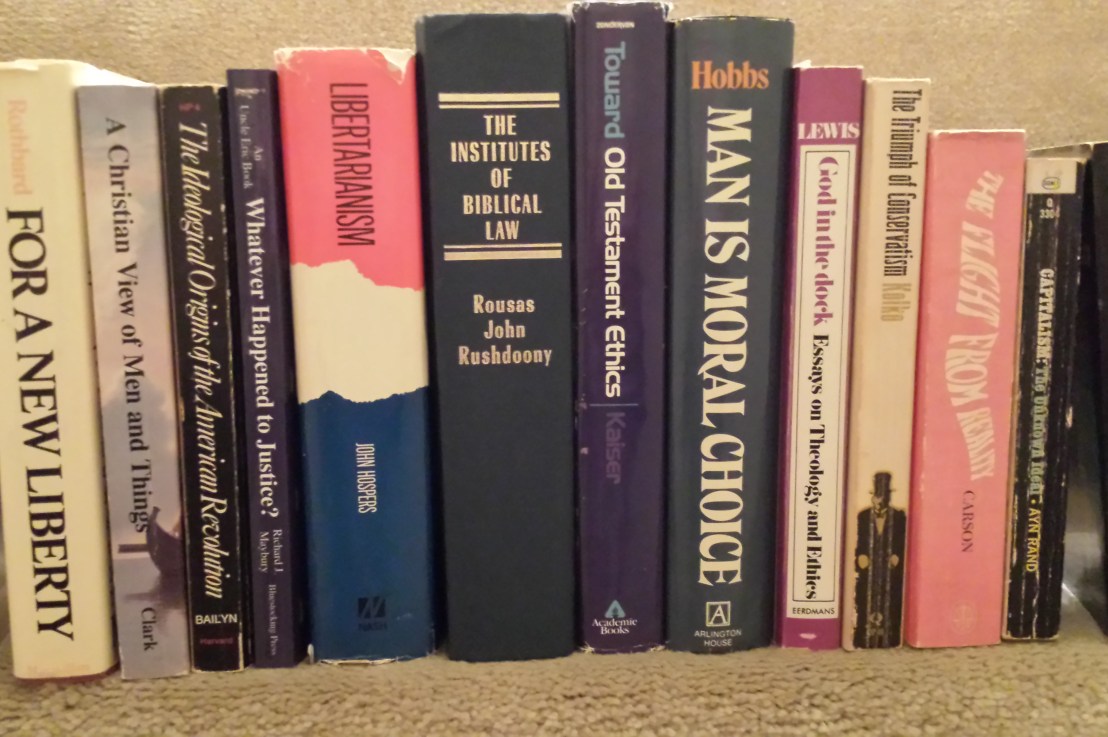
The other day I was looking over the books in my library, facing the tremendous difficulty of trying to decide what books I can remove in order to make way for new books.  It’s such a difficult situation, because a person never knows just what thought or fact you would need to review while trying to make sense of things.  It’s the ideas gleaned from many books that provide the explanatory framework around which new facts are analyzed and fitted.

As I often do, I was thinking of the political scene, and wondering which book(s) would help bring understanding out of the chaos.  How can you make sense out of chaos?  Then my thoughts jumped to the more philosophical question – how can you make sense of randomness?

According to the going scientific story, the world is the result of randomness.  The driver of evolution is the mutation of a gene, a mistake that happens randomly, with no outside direction or teleological goal.   When enough of these happen in a right combination, a new organ or even species is presented for our amazement.  But if the world is, in the final analysis, a random collection of mutations that made good, how can it be made sense of?  Doesn’t ‘making sense’ of something require an order, a blueprint, a design by which to interpret it?

Then my mind went back to a short lecture I heard from a Penn professor quite a few years ago.  It was from what they called “The 60-second lecture series,” in which Penn faculty “distill[ed] a thought into an eloquent and brief message” presented to students and alumni.

In a lecture entitled “the Knowable Universe,” Professor Vijay Balasubramanian  (Physics department) said the following.  “The most amazing thing about this world of wonders is that we can understand it.  It is not at all evident why this had to be the case…there is no compelling reason why the inner workings of the universe should be comprehensible to us.”

That’s exactly the conclusion you must come to when you think about trying to make sense of random mutations.  Of course, you can follow the Existentialists, and decide there truly is no order, so therefore we, as humans, must impose some type of order on the world.  But that obviously doesn’t cut it; even a two-year old knows you fall when you jump off the bed.

Prof. Balasubramanian continued his thought.  “But it (understanding) is the case, and there are two reasons why.  First, underneath all of the immense complexity and apparent randomness of the natural world, there seems to be an intricate order…What is more, the human mind can apparently understand the underlying structure in the universe…there is no compelling reason why the inner workings of the universe should be comprehensible to us.  But they are.  The human mind apparently apprehends the abstract patterns within the universal weave.”

He went on to give an example.  “We can give a complete description of the physics of light in four short equations that would fit on a T-shirt.  Nature is replete with such miraculous orderly relations.”

Without the underlying order, there simply cannot be an understanding, a comprehension of the world around us.  Randomness, on a grand scale, yields chaos, not understanding.

Every one of the books on my shelves, the philosophy, the economics, the history, all attempt to make sense of the universe by applying theories of order, of design, of logical connections.  Naturalism, the current version of our scientific worldview, simply destroys their foundation.

Only the Christian worldview, which sees the world as the result of a logical mind, provides a firm foundation for understanding the world.

(The 60-Second Lecture Series copyrighted 2007 by Univ. Of Penn Trustees)